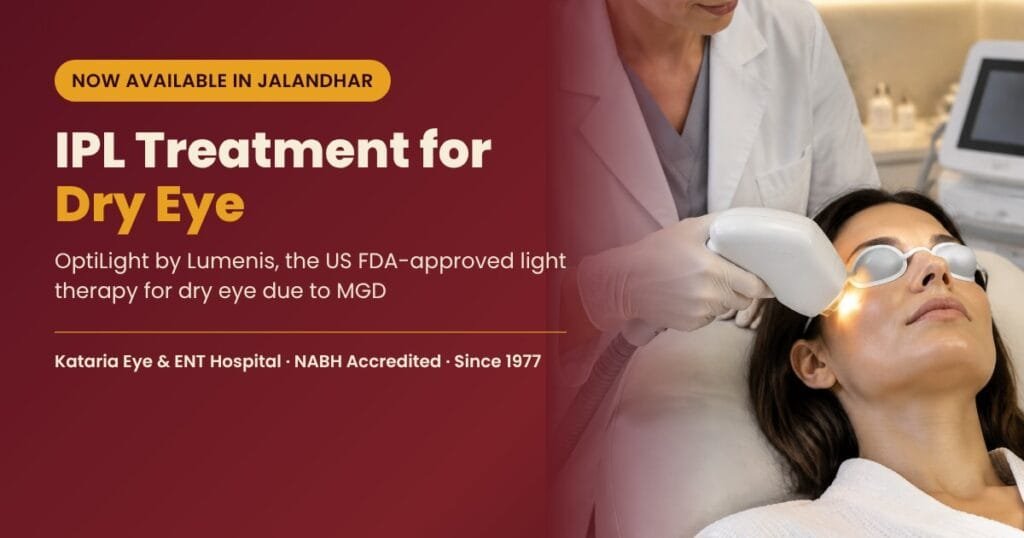
If your eyes burn, feel gritty or sandy, water a lot and still feel dry, or get tired after screen time, you may have evaporative dry eye. Kataria Eye & ENT Hospital in Jalandhar now offers Intense Pulsed Light (IPL) therapy with the Lumenis OptiLight. It is the first IPL device approved by the US FDA to improve the signs of dry eye disease caused by meibomian gland dysfunction (MGD).
This guide explains what IPL is, who it helps, what a session is like, and how it also helps with problems in the skin around the eyes, like redness and visible blood vessels.
Why eye drops alone often don’t fix dry eye
Your tear film has three layers. The thin oily layer on top comes from tiny glands along your eyelid margins, called the meibomian glands. This oil stops your tears from evaporating too fast.
When these glands get blocked or inflamed, which is called meibomian gland dysfunction (MGD), the oil turns thick or stops flowing. Your tears then evaporate within seconds. MGD is one of the most common causes of dry eye. Artificial tears add moisture for a while, but they don’t unblock the glands. That’s why many patients feel only short-term relief from drops.
Things that make MGD worse:
- Long hours on phones, laptops and screens, which make us blink less
- Dust, heat, wind and air conditioning
- Contact lens wear
- Age, hormonal changes and diabetes
- Facial redness or rosacea, and eyelash mites (Demodex)
- Some medicines, and having had LASIK or cataract surgery before
What is IPL therapy for dry eye?
Intense Pulsed Light uses gentle, filtered pulses of light on the skin of the cheeks and around the nose, just below the eyes. The eyes are fully covered with protective shields during the whole treatment. The light is not aimed into the eye.
IPL has been used in dermatology for many years to treat facial redness and visible blood vessels. Doctors noticed that patients treated for facial rosacea also reported less dry eye. The Lumenis OptiLight was then developed specifically for eye care.
How IPL is thought to help:
- Calms inflammation: it targets the small abnormal blood vessels near the lid margins that release inflammatory chemicals into the glands.
- Softens the oil in the glands: the gentle warmth helps the thickened oil flow again.
- Reduces Demodex mites and bacteria on the lids and lashes.
- Prepares the glands for expression: after IPL, your doctor gently presses the glands to clear out the trapped oil.
What the research shows
In 2021, the US FDA authorised the Lumenis OptiLight for “improvement of signs of dry eye disease due to meibomian gland dysfunction”. In the randomised, double-masked study behind this approval (Toyos et al., PLoS ONE, 2022), patients treated with IPL plus gland expression had:
- Almost 7 times more meibomian glands that could release oil
- About 1.5 times longer tear break-up time, meaning a more stable tear film
- More than 3 times better quality of gland oil
- Less discomfort during gland expression, with no light-related adverse events reported
IPL works best as part of a complete dry eye plan. That plan can also include lid hygiene, warm compresses, the right eye drops, and treating the underlying causes.
IPL and the skin around the eyes
The skin around the eyes and the eyelids are closely connected. Many of our dry eye patients also have:
- Ocular rosacea: red, irritated lid margins, often together with redness on the cheeks and nose
- Visible small blood vessels (telangiectasia) on the cheeks and lid margins
- Chronic blepharitis: crusty, itchy lids and lash debris, often linked to Demodex mites
- Recurring styes and chalazia caused by blocked oil glands
Because IPL targets inflamed blood vessels, the same treatment that helps the glands can also reduce redness and inflammation in the surrounding skin. Your doctor will examine both your eyes and the skin around them, and plan treatment for both together.
What happens during an IPL session?
- Dry eye evaluation: we first confirm that MGD is the cause. We check tear break-up time, the glands and the lid margins, and assess your skin type.
- Preparation: a cooling gel goes on your cheeks and nose, and protective shields cover your eyes.
- Light pulses: the doctor moves the handpiece across your cheeks and nose. Most patients feel a mild warm flash, like a rubber band snap. The handpiece has built-in cooling.
- Gland expression: the doctor gently presses your eyelid glands to clear out the softened oil.
- Back to your day: each session takes about 15–20 minutes. There may be some mild redness, which usually fades within a few hours.
How many sessions? The standard OptiLight protocol is 4 sessions, about 2–4 weeks apart. Many patients start to feel better after the second or third session. Some people need a maintenance session every 6–12 months.
Who is a good candidate?
You may benefit from IPL if you:
- Have dry eye due to MGD that hasn’t improved enough with drops and warm compresses
- Have red, irritated lid margins, blepharitis, or keep getting styes
- Have facial redness or rosacea along with eye irritation
- Struggle with contact lens comfort or heavy screen use
- Have dry eye after LASIK or cataract surgery
IPL is not suitable for everyone. Your doctor will check your skin type first, because IPL settings and safety depend on skin tone. It may not be advised if you have a recent tan, active skin infection, pigmented or suspicious skin lesions in the treatment area, are taking photosensitising medicines, have had recent eyelid surgery, or have conditions such as lupus, epilepsy triggered by light, or a history of frequent cold sores. Please share your full medical history at your consultation.
IPL dry eye treatment in Jalandhar: why Kataria Eye & ENT Hospital
- NABH-accredited eye and ENT hospital, caring for Punjab since 1977
- Led by Dr. Sharina Nanda, Eye Specialist and LASIK Surgeon
- Genuine Lumenis OptiLight technology, the FDA-approved IPL for dry eye
- A full dry eye work-up, not just a prescription for drops
- Convenient location: 1, Mahavir Marg, Gujral Nagar, Jalandhar
Frequently asked questions
Is IPL treatment for dry eye painful?
Most patients find it comfortable. You may feel a quick warm snap with each pulse, and the handpiece has built-in cooling. No injections or anaesthesia are needed.
Is IPL safe for the eyes?
Yes, when done by trained eye doctors. Your eyes are fully covered with protective shields, and the light is applied only to the skin of the cheeks and nose, not into the eye. In the FDA study, no adverse events related to the light were reported.
How many IPL sessions will I need?
The standard plan is 4 sessions spaced about 2–4 weeks apart, followed by occasional maintenance sessions if needed.
Can I stop using eye drops after IPL?
Many patients need fewer drops after IPL, but this varies. Your doctor will adjust your drops and lid care routine as your eyes improve.
Is IPL suitable for Indian skin?
IPL safety depends on skin type. Your doctor will assess your skin before treatment and adjust the settings, or recommend another option if IPL isn’t right for you.
Does IPL help with redness around the eyes?
IPL targets inflamed blood vessels, so it can reduce redness linked to rosacea and lid-margin inflammation, along with the dry eye symptoms.
Book your dry eye consultation
Don’t let burning, gritty eyes slow you down. Book a dry eye evaluation at Kataria Eye & ENT Hospital, Jalandhar, and find out whether OptiLight IPL is right for you.
This article is for patient education and is not a substitute for a medical consultation. Treatment suitability and results vary from person to person.